


Summary
Attachment theory has given us something genuinely valuable: a precise language for the ways early relational experience shapes the nervous system’s strategies for love, trust, and belonging. The anxiously attached person who cannot stop reaching, the avoidantly attached person who cannot stop withdrawing — these patterns are real, and the developmental histories that produced them matter enormously. But attachment theory shares an assumption that deserves examination: it locates psychological reality primarily in the individual. It asks what happened to this person, what strategy this nervous system developed, what wound is being expressed here. Jung spent his life asking psychology to widen exactly this frame. The individual is always participating in a reality greater than the individual. The identified patient in a family system is not always the source of pathology — they are sometimes its first honest expression, the person in whom what the entire system cannot bear has finally become visible. I find myself wondering whether intimate relationship deserves the same expansion. When the Mercurial Field between two people carries a tension that the vessel between them is not yet capable of holding, that tension has to go somewhere. And it goes, with the unerring precision of the unconscious, to the nervous system most organized to receive it. Before concluding that one nervous system is disordered, we might first ask a more difficult question: what is this nervous system carrying that the relationship itself has not yet become capable of holding?
The alchemical tradition had a precise term for the vessel that makes transformation possible: the temenos — the protected, consecrated container in which opposing substances could be held together long enough for something genuinely new to emerge from their encounter. Without the temenos, the fire scatters. The tension resolves prematurely, one way or another, before the transformation it was carrying has a chance to complete itself. In intimate relationship, the temenos is the consciously protected space in which ambiguity, conflict, longing, misunderstanding, desire, and grief can remain alive long enough to be transformed rather than prematurely resolved. It is not a technique or a communication framework. It is a quality of shared commitment to the living field between two people — the recognition that what exists between them is worth tending, and that both people are responsible for tending it. Secure attachment in its deepest form may be less an individual accomplishment than a shared one: not one regulated nervous system alongside one that is learning to regulate, but a vessel built deliberately over time, capable of containing the full charge of the Mercurial Field without either person having to carry that charge alone. The goal, then, is not only the regulation of individual nervous systems, however important that remains. It is also the slow, conscious creation of a temenos — a relational container capable of holding the fire of transformation long enough for love to become something neither partner could have created alone.
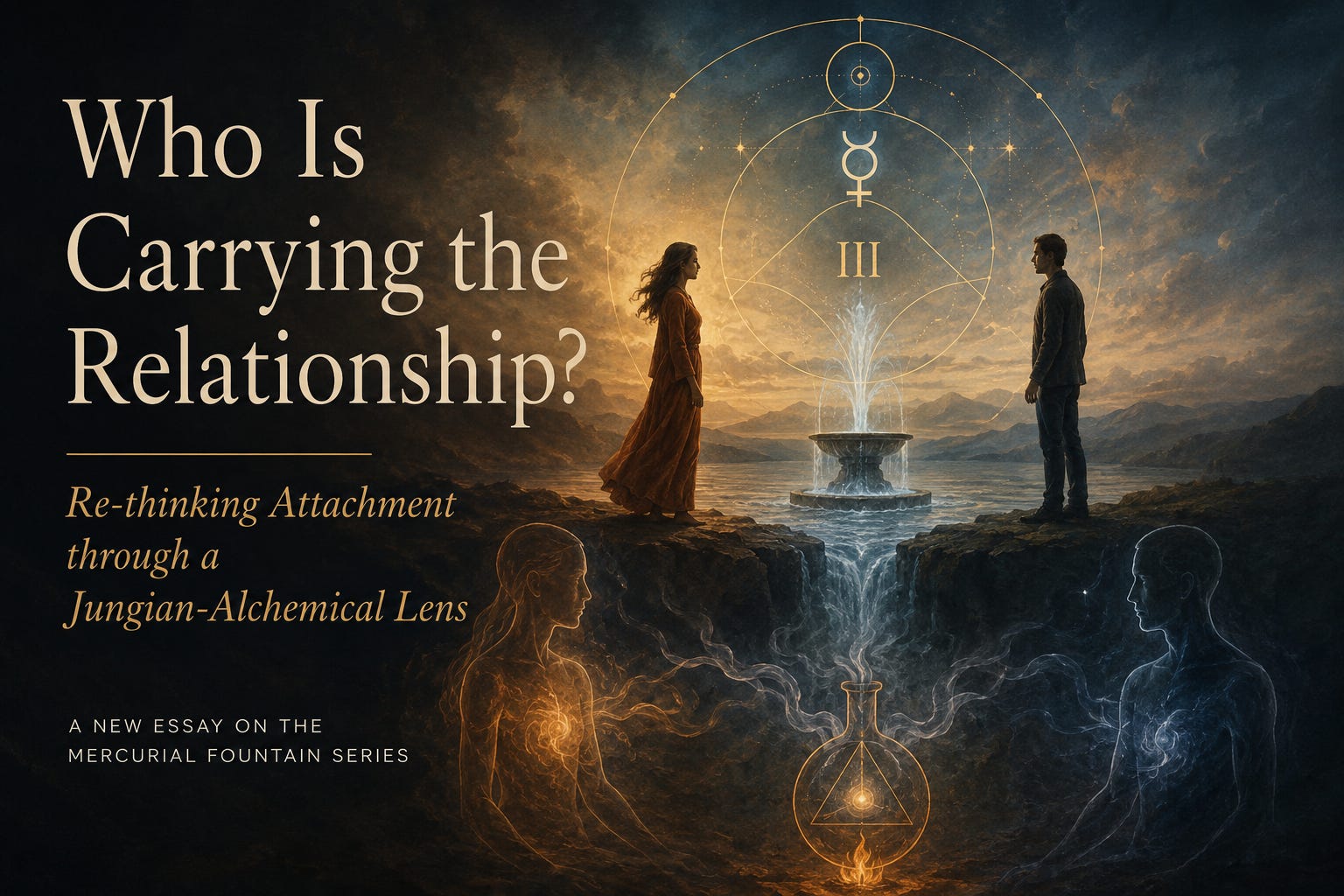
Attachment theory has transformed our understanding of intimate relationships.
Few psychological frameworks have so profoundly illuminated the invisible ways our earliest experiences shape the capacity to love, trust, and belong. It has given language to what so many people have lived without being able to name: the anxious attachment that cannot stop reaching, the avoidant attachment that cannot stop withdrawing, the disorganized attachment that does both simultaneously and understands neither. It has helped us recognize that the nervous system is not merely biological machinery but a deeply relational instrument, shaped from the beginning by the quality of presence — or absence — it encountered in the people it most needed.
I draw on this framework regularly in clinical work.
And I find myself wondering whether it is asking a question that is, in one specific and important way, too small.
The Question Behind the Question
When a nervous system becomes overwhelmed in intimate relationship — when one partner cannot stop pursuing, and the other cannot stop withdrawing, when conflict produces flooding that neither person can metabolize, when the cycle repeats itself regardless of how much both people understand it intellectually — the attachment framework asks a precise and genuinely useful question:
What happened to this person? What strategy did this nervous system develop in order to survive its earliest relational environment?
These are important questions. They are often the right questions to begin with.
But they share an assumption that I think deserves examination.
They locate psychological reality primarily in the individual.
The nervous system is dysregulated. The attachment wound is here, in this person’s developmental history. The work is to regulate this nervous system, repair this wound, develop the security that early experience failed to provide.
Jung spent his life asking psychology to widen exactly this frame.
For Jung, the individual psyche could never be understood in isolation. Dreams are not merely personal — they carry material from a depth that exceeds the individual’s biography. Symptoms are not merely personal — they often express tensions the collective has not yet been able to recognize or contain. The identified patient in a family system is not always the source of pathology. They are sometimes its first honest expression — the person in whom what the entire system cannot bear has finally become visible.
The symptom is real.
But its origin may not lie solely within the individual who is carrying it.
I find myself wondering whether intimate relationship deserves the same expansion.
When two people enter the Mercurial Field I described in the previous essays in this series — when they stand at the edge of the fountain and encounter the living third reality that neither of them created and neither of them owns — where do the unresolved tensions of that field go when the vessel between them is not yet capable of holding them?
Perhaps they do what psychic tensions have always done.
They seek a carrier.
What the Nervous System May Be Carrying
In the previous essay, I described the Axiom of Maria — the alchemical map of how the relational field develops from One through Two through Three toward the emergence of a fourth, the soul of the relationship itself. The passage from One to Two is the passage in which the mirror cracks: the projection dissolves enough for genuine difference to appear, and the field between two people becomes charged with a tension that neither person anticipated and neither knows how to hold.
This is the moment most relationships most need a vessel.
And it is the moment most relationships discover they do not yet have one.
When that relational vessel is insufficiently developed — when the third entity between two people has not yet become stable enough to hold the tension of genuine difference — the psychic charge has to go somewhere. And it goes, with the unerring precision of the unconscious, to the nervous system most organized to receive it.
One partner becomes anxious. The other withdraws.
One pursues. The other distances.
One floods; the other numbs.
Psychology names these patterns attachment styles — and often those descriptions are accurate as far as they go. The anxiously attached person does carry a wound from early relational experience. The avoidantly attached person did learn, in some developmental environment, that the safest response to need was to suppress it. These histories are real.
But I want to ask a more difficult question before concluding that what we are witnessing is always, or only, an individual disorder.
What if the nervous system is also carrying tensions that belong to the relationship itself?
What if what we call anxious attachment is, in some cases, one organism faithfully metabolizing a charge that the field between two people has not yet become capable of holding consciously? What if the withdrawal of the avoidant partner is not only a personal defense but also the relational system’s attempt to regulate a tension that has exceeded the vessel’s current capacity?
I am not suggesting this replaces the attachment account. I am suggesting it may need to sit alongside it — because the implications for how we understand healing are significantly different depending on which frame we are working in.
The Scapegoat and the System
This question has occupied me for much of my clinical life, because I have spent years thinking about the psychology of the scapegoat.
In every family system, one member often carries what the entire family cannot bear. The identified patient presents with the symptom. The symptom is real — the suffering is real, the dysregulation is real, the wound is real. But the conflict that generated the symptom belongs to the system, not only to the individual who is expressing it. Treating only the identified patient, without addressing the system that required someone to carry what it could not face, produces the particular therapeutic frustration of watching a person make genuine progress in the consulting room and then return, week after week, to an environment organized to reinstate the dynamic that produced the symptom in the first place.
Jung understood this intuitively.
The individual is always participating in a reality greater than the individual.
I wonder whether intimate relationships occasionally function in an analogous way. Perhaps the nervous system that is most activated in a relationship is not always the most wounded one in a simple biographical sense. Perhaps it is sometimes the one that, for reasons related to the specific chemistry of this particular pairing, has become the carrier of what the field between these two people has not yet become capable of consciously holding.
If that is true, then the question shifts.
Not: what is wrong with this nervous system?
But: what is this nervous system carrying that the relationship itself has not yet become capable of holding?
The Temenos
The alchemical tradition had a precise term for the vessel in which transformation becomes possible: the temenos.
In ancient Greek, temenos referred to a sacred precinct — a delimited, protected space set apart from ordinary life for a specific purpose. In the alchemical tradition, it became the name for the sealed container, the vas hermeticum, in which the opposing substances could be held together long enough for something new to emerge from their encounter. Without the temenos, the chemical wedding could not occur. The fire would simply scatter. The tension would resolve prematurely, one way or another, before the transformation it was carrying had a chance to complete itself.
I introduced the Mercurial Field in the first essay of this series. I described the Axiom of Maria in the second. The temenos is the third essential element — and it is, I think, what is most frequently absent when relationships fail not from a lack of love but from a lack of container.
The temenos in intimate relationship is the consciously protected space between two people in which ambiguity, conflict, longing, misunderstanding, desire, grief, and love can remain alive long enough to be transformed rather than prematurely resolved. It is not a technique. It is not a communication framework or a conflict resolution protocol. It is a quality of shared commitment to the living field between two people — a recognition that what exists between them is worth protecting, requires more than individual regulation, and is something both people are responsible for tending.
This is where contemporary attachment theory, for all its genuine contributions, remains incomplete.
Secure attachment is understood, within that framework, primarily as the achievement of a well-regulated individual nervous system — the internalized security object, the earned security that therapy can help develop in adults whose early environment failed to provide it. These are real achievements, and they matter enormously.
But I wonder whether secure attachment, in its deepest form, is more than an individual accomplishment.
Perhaps it emerges — can only fully emerge — when two people consciously create a relationship capable of holding what neither person can carry alone. Not one regulated nervous system and one that is learning to regulate. But a shared vessel, built deliberately over time, capable of containing the full charge of the Mercurial Field without either person having to carry that charge in their nervous system because the relationship itself has nowhere to put it.
That is the temenos.
And its creation is not incidental to the relationship.
It may be the relationship’s primary work.
A Different Question
This does not eliminate personal responsibility. It does not deny the real and lasting influence of early attachment wounds, or suggest that individual therapeutic work is unnecessary. The developmental history matters. The nervous system’s learned strategies matter. The specific wounds each person carries into the field matter enormously for what the field will initially activate and what it will initially avoid.
But it invites us to hold that individual account inside a larger frame.
When one partner floods and the other withdraws, before asking what is wrong with each of these nervous systems individually, we might also ask: what has the relationship not yet become capable of holding that these nervous systems are now being required to carry?
When the cycle repeats despite genuine effort and genuine insight, before concluding that the work has failed, we might ask: is there enough of a vessel here to hold what is trying to move through this field?
When one person carries the anxiety and the other carries the distance, before treating each as a separate individual disorder, we might ask: is this the field’s tension finding its carriers — and what would it mean to build a container strong enough that neither person has to carry it alone?
These are not small shifts.
They change what we are trying to build.
The goal is no longer only the regulation of individual nervous systems, however important that remains.
The goal is also the slow, deliberate, conscious creation of a temenos — a relational vessel capable of holding the fire of transformation long enough for love to become something neither partner could have created alone.
What Jung Understood
For Jung, the individual was never merely an individual.
The individual was the place where the collective became conscious — where the larger, transpersonal realities that exceed any single biography sought expression, asked to be carried, demanded to be transformed.
I find myself wondering whether our nervous systems sometimes serve a similar function in love.
Not only revealing our childhood, though they do that.
Not only expressing our attachment strategies, though they do that too.
But sometimes revealing what the relationship itself has not yet become capable of carrying — acting as the faithful, suffering indicator of a tension that belongs to the field between two people, and that will continue to seek a carrier until the field develops a vessel strong enough to hold it consciously.
If that is true — and I believe it often is — then healing is not only about regulating the individual nervous system.
It is also the building of the temenos.
The creation, together, of the protected space in which what Mercury carries between two people can remain alive long enough to complete its work.
Not resolved prematurely.
Not carried indefinitely by one nervous system alone.
But held, consciously, in the vessel that genuine relationship — when it is willing to become one — actually is.
This work continues inside my free community:
https://www.skool.com/the-genius-circle
Recommended Reading
Protecting the Mercurial Field in Romance — The first essay in this series: on the Mercurial Fountain, the Fisher King’s wasteland, and the first task of relationship.
Mercury and the Field Between Us — The second essay: on the Axiom of Maria, the soul of the relationship as a living third entity, and why the field must be returned to rather than achieved.
When Reality Becomes the Symptom — On the scapegoat dynamic in its most concentrated form: when the symptom appears in the individual, and the conflict belongs to the system.
When the Soul Never Grows Its Hands — On the individuation work that must precede the capacity to help build and tend a genuine temenos with another person.
From Polarity to Alterity: The Future of Human Belonging — On what becomes possible when a field develops the capacity to hold genuine difference — the relational condition that the temenos is built to sustain.
Dr. Bren Hudson is a Jungian-oriented analyst in private practice with a Buddhist orientation. This essay is part of an ongoing series exploring interiority, the anti-Self structure, and the collapse of relational being in contemporary culture.