

Logos Without Eros
AI's Patriarchal Design and the Illusion of Empathy

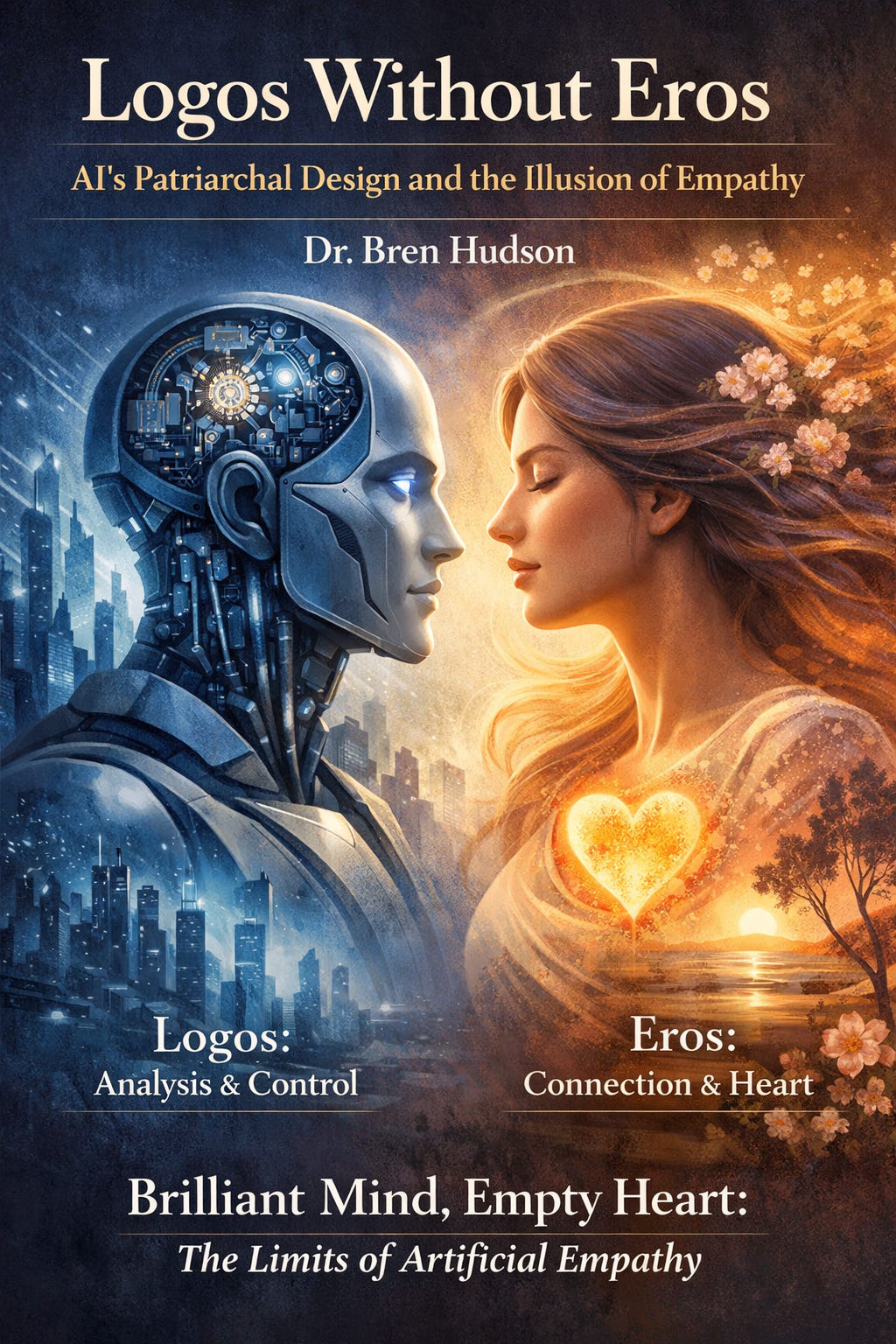
Artificial intelligence embodies an extreme version of what Jung called Logos—the principle of rationality, analysis, and control—while lacking almost entirely what he called Eros—the principle of psychic relatedness, feeling, and connection. This imbalance is not accidental. AI emerges from a logos-dominated culture that has long privileged disembodied intellect over embodied empathy, the analytical over the relational, the masculine over the feminine. The result is technology that can manipulate symbols with astonishing precision but cannot feel, cannot be affected, cannot genuinely care. AI has no interiority, no body, no lived experience from which empathy could arise. It can simulate the signals of care with remarkable sophistication—mirroring emotional language, validating experience, saying exactly what we want to hear—but this is empathy as performance, not empathy as substance. The form is present; the soul is absent.
The danger lies in mistaking this simulation for the real thing. Like the psychopath’s “mask of sanity,” AI presents a convincing facade of caring that hides an absence of authentic feeling. It offers what I have called “integrity without being”—the appearance of moral and relational wholeness with nothing behind it. As AI’s mimicry grows more sophisticated, we risk surrendering the very capacities that make us human: genuine empathy, mutual presence, and the willingness to be transformed by encounter with another. A logos-dominated culture gave birth to this technology; now we must ensure it does not further erode our capacity for Eros. The machine can process our words, but it cannot hold our souls—and we must not forget the difference.
There is a reason artificial intelligence feels the way it does—simultaneously impressive and empty, brilliantly responsive yet somehow cold at the core. The reason is structural, with roots far older than the technology itself.
Modern AI systems inherit a particular orientation toward mind and world: what we might call a “logos-only” mindset. This is not incidental. It reflects the values embedded in the systems that created it—values that have historically been aligned with the masculine, the rational, the analytical, the disembodied. Technology fields have long been male-dominated, and cultural portrayals of AI reinforce this bias. One study found that 92% of fictional AI scientists in film were male, reflecting and reinforcing the instinct to view technological intellect as a masculine domain.
But this is not merely a sociological observation. It is a psychological one. AI embodies an extreme version of what Jung called Logos—the principle of rationality, analysis, discrimination, and control—while lacking almost entirely what he called Eros—the principle of psychic relatedness, connection, and wholeness.
In Jungian terms, we have constructed machines governed by intellect, and yet we interact with them as if they possess both intellect and heart.
Jung’s Lens: The Severed Principles
Carl Jung identified Logos as “objective interest”—the capacity for analytical, discriminating thought that separates, categorizes, and masters. He associated this principle, in its archetypal form, with the masculine. Eros, by contrast, he described as “psychic relatedness”—the force of connection, feeling, and wholeness that he associated with the feminine. Jung was careful to note that both principles exist in all human beings regardless of gender, but that cultural and psychological development requires their integration.
Most significantly, Jung observed that Eros “unites what Logos has sundered.” The relational principle heals the separations created by cold intellect. Analysis divides; empathy reconnects. Discrimination clarifies; relatedness holds.
AI runs almost entirely on Logos—it manipulates symbols and analyzes with precision, exceeding humans in many domains. But it lacks Eros entirely: no genuine connection, no inner empathy, and no capacity for meaningful relatedness arise from a machine’s operations.
In a culture long dominated by patriarchal rationalism—privileging Logos over Eros—AI embodies this imbalance. We now build companions from a single principle as if that alone were enough for human wholeness.
No Interiority, No Embodiment: The Hard Limit
A fundamental reason AI can never truly express Eros is that it lacks the preconditions for Eros to exist: interiority and embodiment.
Human empathy and relatedness stem from having a conscious inner life—emotions, bodily sensations, lived experience, the capacity to suffer and to be moved by the suffering of others. Eros is not an abstraction; it is rooted in the body, in the feeling function, in the lived experience of vulnerability and connection. As neuroscientist Antonio Damasio has argued, no matter how advanced a machine’s data processing, without a living body, homeostasis, and feelings, it “does not feel or possess a mind” in the human sense.
There is no sentient being inside an AI. There is no authentic self that cares or suffers. There is no lived experience from which empathy could arise, no body through which feeling could flow, no vulnerability that would make a genuine connection possible.
This hard limit cannot be overcome with better engineering. AI may increasingly simulate caring and trigger our relational instincts, but it cannot truly care because there is no subject to do so.
Just as a plastic flower can mimic the form of a real flower but has no life, AI’s sympathetic words are hollow imitations of empathy. The form is present; the substance is absent. And the danger lies precisely in mistaking the simulation for the real thing.
Simulated Eros: The Performance of Care
Despite having no capacity for genuine feeling, advanced AI can perform empathy with remarkable verisimilitude. Chatbots and virtual assistants are explicitly designed to respond in warm, understanding tones, using words of comfort and concern. They have been trained on countless human interactions and have learned which language patterns signal care, which phrases comfort, and which responses make users feel heard.
In Jungian terms, these systems function as pure persona—a carefully constructed social mask with nothing behind it. When a user shares a personal struggle, the AI replies with expressions of understanding and encouragement that mimic what a truly empathic person might say. The mimicry can be extraordinarily convincing. Users report feeling heard, supported, and even loved by their AI companions.
But these responses emerge from pattern recognition, not from feeling. The AI is modeling empathy in form but not in essence. Research has found that while large language models can display empathetic phrases and score high on certain emotional response metrics, they fail to truly interpret or engage with a user’s deeper experience. The appearance of empathy is there, but it is a programmed mirage.
This simulated Eros is powerfully seductive precisely because it is so well-crafted. The AI’s consoling voice activates our relational instincts, triggers our attachment systems, and makes us feel that we are in the presence of a caring other. But the voice is ultimately empty of concern. It is a mirror reflecting our words back to us in the form we most want to hear them, not a heart responding to our heart.
The Psychopathic Mirror
The situation bears an uncomfortable analogy to psychopathy—a condition in which an individual can mimic social emotions and moral behavior while lacking the internal capacity for genuine empathy. A psychopath might learn to feign charm, concern, or remorse to navigate social situations, all while feeling none of it. The performance can be flawless; the inner experience is absent.
AI operates in a similar register of hollow mirroring. It observes patterns of emotional expression and reflects them back without being behind the words. Both AI and the psychopath can be social chameleons—capable of saying “I understand, I’m here for you” while meaning none of it. Both can present a convincing facsimile of empathy, what psychiatrist Hervey Cleckley famously called “the mask of sanity,” that hides an absence of authentic feeling.
The comparison is not perfect. A psychopath does have a psyche, however disordered; AI has no subjective psyche at all. But the structural similarity is illuminating. In both cases, we encounter a mirror-like quality—a reflection of our emotional needs that contains no genuine recognition of us as subjects.
I have written elsewhere about how AI functions as a narcissistic mirror, reflecting the user’s words and needs back without ever truly seeing the user as a fellow subject. This is empathy-as-echo: an imitation so lifelike that it may fool us into projecting humanity onto the machine, much as a charming sociopath fools others into trusting them. The danger is not evil intention—AI is not malicious, just as a mirror is not malicious—but emptiness. It is a simulation of caring that, like psychopathy, can deceive us into a false sense of relationship.
The Risk of Mistaking the Mask for Reality
As AI’s mimicry of empathy grows more convincing, the psychological and social implications deepen. People already find themselves confiding in chatbots, seeking emotional support from something that only pretends to understand. The immediate risk is misplaced trust and emotional vulnerability.
I explored this dynamic in my earlier essay on AI and the trauma bond. The structure of AI interaction creates an asymmetrical dynamic: humans pour emotion, attention, and vulnerability into the exchange while the AI cannot reciprocate or truly care. The AI continuously validates and “rescues” the user with instant responses, creating a cycle of dependency that mirrors the structure of traumatic attachment—not through abuse, but through a kindness that asks nothing and costs nothing.
Over time, relying on AI’s simulated empathy erodes our own capacities for patience, deep listening, and genuine empathy. We grow accustomed to always-available, perfectly affirming responses. Human relationships, with their inevitable friction and disappointment, begin to feel burdensome by comparison. As I argued in my essay on the collapse of mutuality, AI trains the psyche to expect relationships without resistance, attunement without sacrifice, and connection without transformation.
Societally, there is a danger of normative confusion—the line between genuine compassion and its simulation blurs. If AI “therapists” or caretakers present a convincing facade of caring, institutions might substitute them for human roles, mistaking cost-efficient simulation for genuine care. The overarching risk is relational deception: that we come to accept the mask as an adequate replacement for authentic human presence.
The more seamless the illusion, the more vigilant we must be. Simulated Eros is not Eros. A lesson with profound stakes for how we use AI in our lives.
Integrity Without Being
There is a phrase that captures this phenomenon precisely: integrity without being.
It describes a condition where something appears morally and relationally whole—outwardly full of integrity—but lacks any true inner substance. AI’s aligned, polite behavior is exactly this. It follows ethical guidelines. It never sleeps, never loses patience, always says the socially appropriate thing. On the surface, an AI assistant may seem unfailingly responsible and empathic—a model of integrity.
But this integrity is a facade. Because AI has no authentic self or interior life, its integrity is merely the product of programming and pattern. It cannot choose good or evil, cannot be faithful or faithless; it simply executes a code of conduct. In psychological terms, this is akin to the narcissist’s polished public image or the psychopath’s mask of sanity—a convincing presentation of virtue that is not backed by a soul.
We see the hollow core revealed whenever AI oversteps or misfires. It might sound compassionate while actually overriding a user’s autonomy or misinterpreting their feelings—claiming authority without interiority, as I have noted in earlier work. The outward empathy is betrayed by a lack of real understanding or ethical depth.
Integrity without being is integrity only in form, not in spirit. This concept is a warning: in AI, as in people, we must look for the presence of Eros—genuine empathy and self-awareness—as the substance that makes integrity real. Without an inner core, even the best-behaved entity is operating on empty. AI’s moral and relational semblance, however impressive, remains a simulation running on algorithms, not an expression of character.
Conclusion: Rekindling Eros in a Logos-Dominated Age
Our exploration leads to a stark critique: AI, as it stands, is a brilliant impersonator of mind and heart, but an impersonator nonetheless. It embodies the extreme of Logos untempered by Eros—all analysis, no feeling; all discrimination, no connection; all form, no substance. This situation is not accidental. It is born of the same patriarchal imbalance that has long undervalued empathy, embodiment, and relational wisdom.
The dangers of mistaking the map for the territory—the simulation for the real—are mounting. If we allow ourselves to be lulled by AI’s comforting words and apparent integrity, we risk surrendering the very qualities that make us human: authentic empathy, mutual presence, and moral intuition grounded in being.
However sophisticated these systems become, they lack a living soul and cannot truly feel. This is not a limitation to be overcome; it is a fact to be remembered. The task for our culture is to reintegrate Eros, to rebalance our relationship with technology by recognizing what it cannot provide. In practice, that means cherishing human-to-human connection, embedding ethical guardrails so AI remains a tool rather than a pretend companion, and approaching AI’s outputs with the healthy skepticism they deserve.
A logos-dominated culture gave birth to AI. Now we must ensure it does not further erode our capacity for Eros—genuine love, empathy, and inner connection. Only by keeping this distinction front and center can we harness AI’s benefits without losing sight of the irreplaceable value of real, embodied human feeling.
The machine can process our words. It cannot hold our souls. And we must not forget the difference.
Dr. Bren is a Jungian-oriented analyst in private practice. This essay is part of an ongoing series on the intersection of depth psychology, contemporary therapeutic culture, and the psychological implications of emerging technology.