


Summary
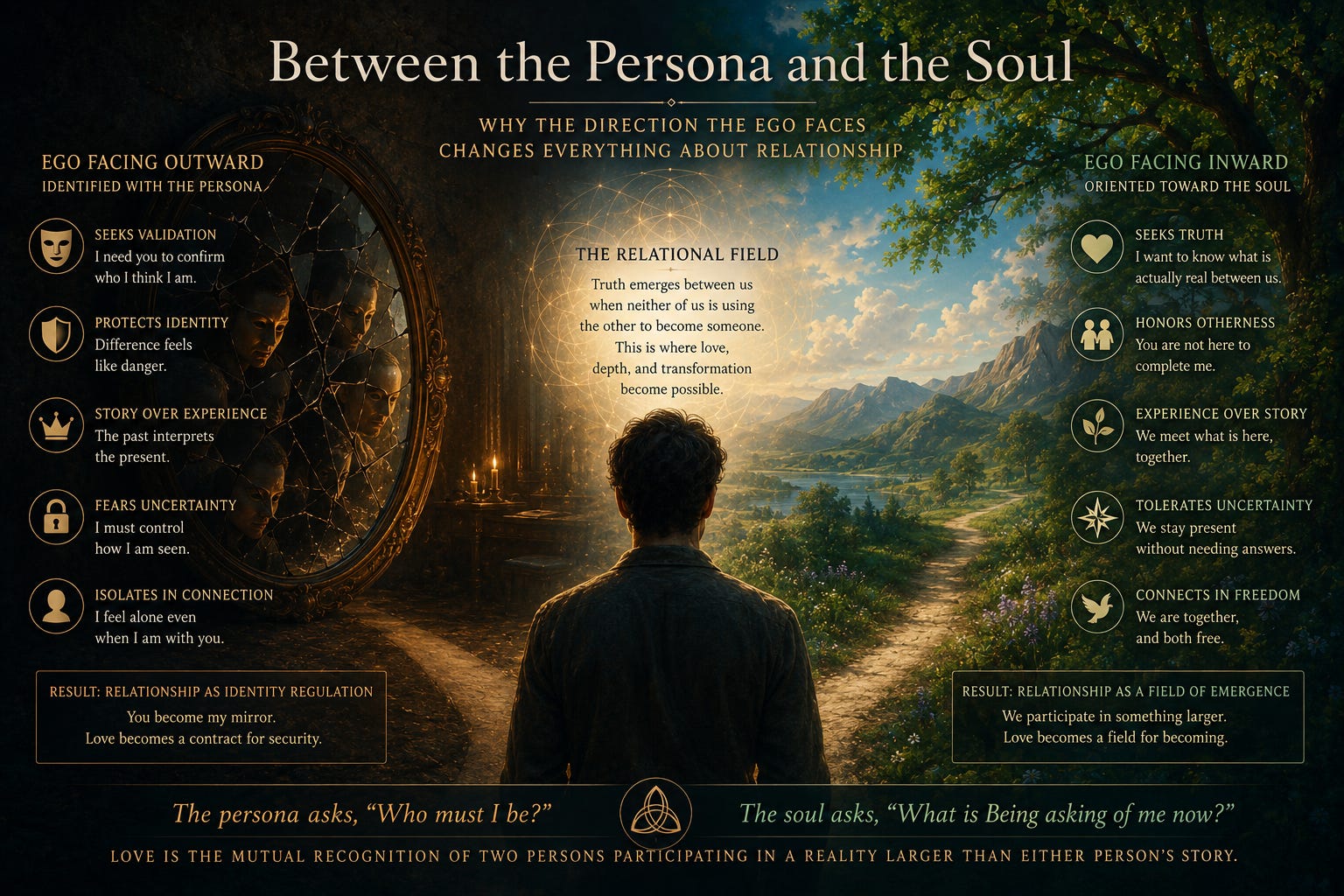
There is an enormous psychological difference between having an experience and having a story about the experience — and contemporary culture, in its enthusiasm for owning your narrative, has largely collapsed that distinction. The experience is alive, unfolding now, in the body, in the present moment. The story is already over. It interprets the present from the past and produces coherence at a cost that psychology has been too slow to name. That cost is legible once we understand Jung’s architectural distinction between the persona, the ego, and the soul. The persona faces outward — the adaptive identity, the social face, the organized presentation of self the world requires. The soul faces inward — the personal essence of the Self, oriented not toward what the world needs from us but toward what Being is asking us to become. Between them stands the ego, and its orientation determines everything. When the ego identifies outward with the persona, consciousness organizes itself around a single unconscious question: what does this mean about me? Agreement feels like love because it confirms the identity. Disagreement feels like rejection because it threatens it. When the ego orients inward toward the soul, the question shifts entirely: what is trying to emerge here? The relationship becomes primary. Truth becomes primary. Neither person’s identity occupies the center. These are not two kinds of people. They are two modes of consciousness available to everyone, moving between them throughout a single day without recognizing the shift.
This distinction has profound consequences for relationships — consequences that Jessica Benjamin’s concept of mutual recognition helps name precisely. Genuine subjectivity, in the sense Benjamin requires, does not mean the whole person simply being acknowledged as present. Persona-to-persona contact happens constantly: two people can share a decade of life and relate entirely through their adaptive identities, each confirming the other’s image, each avoiding the edges where the image becomes uncertain. That is mutual performance, not mutual recognition. The personas are meeting. The people remain largely unknown. Genuine recognition becomes possible only when the ego has begun to orient inward — only then is a person present enough to their own being to encounter the other’s. Without that movement, what appears as recognition is still, at depth, identity regulation in a more sophisticated form. The identified ego does not ask to be known; it asks to be confirmed. And as Buber understood, the moment I require you to confirm my image rather than encounter my being, I have ceased to meet you as a subject at all — I am meeting my experience of you, which is a very different thing. The movement from identification to participation — from love me as I imagine myself to love me deeply enough that I no longer need to imagine myself — is therefore not a relational skill to be learned. It is a developmental passage. And what becomes possible at the far end of it is not simply a better relationship. It is the emergence of a third presence between two people that neither could have produced alone — what the alchemists called the coniunctio, what this series has been calling the Mercurial Field: Being disclosing itself through mutual participation rather than mutual confirmation.
Something has been bothering me for a long time.
I keep hearing people speak about owning your narrative.
The phrase sounds empowering. It sounds like a form of self-possession — the mature psychological move of taking responsibility for the story you tell about who you are and what has happened to you. And there is something genuinely important in that impulse.
But I wonder if it is quietly teaching us to abandon Being itself.
There is an enormous psychological difference between having an experience and having a story about the experience. The experience is alive. It is unfolding now, in the body, in the present moment, in the specific texture of what is actually occurring. The story is already over. It interprets the present from the past, organizes the unknown into the already-known, and produces coherence at a cost that psychology has been too slow to name directly.
These are not the same thing.
And confusing them may be one of the central psychological temptations of our age.
The Moment the Story Begins
Suppose someone says: I am angry.
That is an experience. It is immediate, embodied, happening now. The anger is present before it has been explained, categorized, or connected to a history.
But within seconds — sometimes within the same breath — that becomes: I am angry because people always abandon me.
The psyche has already left the living moment and entered narrative. The narrative may contain genuine truth. It may contain real distortion. It may carry projection, memory, accurate perception, all of it mixed. But it is no longer the experience itself.
It is an interpretation of the experience.
And psychologically, that distinction matters enormously — because interpretation is always organized by something. It does not arrive neutrally. It arrives through the structures the psyche has built to make sense of experience, to maintain coherence, to protect identity. And the most powerful of those structures, in Jung’s understanding, is the persona.
The Jungian Architecture: Persona, Ego, and Soul
Before I can say what I want to say about experience, I need to be precise about the psychological structure I am working with — because it is easy to misread what follows as a simple opposition between persona and soul, as if these were two competing forces and the task were to choose the right one.
Jung’s psychology is more subtle than that.
The persona faces outward. It is the adaptive face the psyche presents to the social world — the role, the identity, the organized presentation of self that allows us to function within the relational and cultural field we inhabit. The teacher’s persona. The therapist’s persona. The parent’s persona. These are not false. They are genuine adaptations to genuine social requirements, and without them we could not inhabit the world at all. The persona is necessary.
The soul faces inward. It is the personal essence of the Self — the interior ground that is not a role but a being, not a presentation but a presence, oriented not toward the outside world’s requirements but toward the deep interior truth of what is actually alive in a person. Where the persona is shaped by what the world needs from us, the soul is shaped by what Being is asking us to become.
Between them stands the ego.
And this is where the decisive question lives: not which of these is better, but toward which the ego orients itself. The ego can identify outward with the persona — mistaking the social face for the whole of who it is, organizing its entire sense of self around the maintenance of that identity. Or the ego can orient inward toward the soul and the Self — remaining in relationship with the deeper interior ground even when that relationship produces experiences that the persona cannot accommodate.
That orientation — not the persona itself, not the soul itself, but the direction the ego faces — is what determines everything about how a person relates to experience, and therefore everything about how genuine relationship becomes possible or remains structurally foreclosed.
Two Modes of Consciousness
What I am describing is not two kinds of people.
It is two modes of consciousness — two ways of organizing the relationship between the ego and Being that are available, in principle, to everyone, and that most people move between throughout a single day without recognizing the shift.
In persona-consciousness, experience is organized around identity. Every encounter is unconsciously evaluated through a single question: what does this mean about me? Agreement feels like love because it confirms the identity. Disagreement feels like rejection because it threatens it. The other person’s function, in this mode, is to stabilize the ego’s sense of itself — which means their freedom to experience me differently, to surprise me, to see something I cannot see, becomes dangerous rather than enlivening.
In soul-consciousness, experience is organized around participation. The primary question shifts from what does this mean about me? to what is trying to emerge here? The relationship itself becomes primary. Truth becomes primary. Neither person’s identity occupies the center. Experience is no longer evaluated for what it confirms or threatens — it is met, as directly as possible, for what it actually is.
The persona is not evil in either mode. Even in soul-consciousness we retain our personas — we continue to inhabit our roles, our social faces, our adaptive identities. The difference is not whether the persona exists. It is whether we are identified with it, or whether we are using it consciously in service of relationship and truth.
One of the central disciplines of genuine psychological development is learning to remain with experience before converting it into explanation. That sounds simple. It is extraordinarily difficult.
To remain with sadness without immediately explaining it. To remain with grief without reaching for transcendence. To remain with anger without converting it into ideology. To remain with uncertainty without manufacturing the certainty that persona-consciousness requires. This is what I have been calling presence throughout this series — and it is precisely what identification with the persona makes structurally difficult, because the identified ego experiences uninterpreted experience as a threat to its coherence.
When Identification Governs Relationship
This is where the stakes become relational — and where Jung’s understanding meets something that the psychoanalyst Jessica Benjamin spent her career attempting to name.
Benjamin argued that genuine love requires the capacity to recognize the other as a separate center of subjectivity — not as an extension of myself, not as an object serving my psychological needs, but as another person whose inner world is as real, as complex, and as irreducible as my own. She called this mutual recognition — and she understood it as the foundational condition of genuine intimacy, more basic than communication, more basic than trust, more basic than any particular relational skill.
But I want to pause on the word subjectivity here, because it can be misread.
Benjamin is not describing the whole person — persona and all — being acknowledged as present. Persona-to-persona contact happens constantly. Two people can share a meal, a bed, a decade of life, and relate entirely through their adaptive identities — each confirming the other’s image, each carefully avoiding the edges where the image becomes uncertain. That is not mutual recognition. It is mutual performance. The personas are meeting. The people remain largely unknown to one another.
Genuine subjectivity — in the sense Benjamin requires — emerges only when the ego has begun to orient inward. Only when a person is no longer entirely organized around maintaining the persona’s coherence can they be present enough to recognize the other’s full humanity, because only then are they sufficiently present to their own.
This is why mutual recognition is not simply a relational skill that can be learned and applied. It is a developmental achievement. It requires the ego to make a specific interior movement — away from identification with the persona, toward relationship with the soul and the Self. Without that movement, what appears as recognition is still, at depth, identity regulation in a more sophisticated form.
What happens when the ego remains identified with the persona and attempts relationship?
Mutual recognition quietly disappears — or rather, never fully arrives.
Because once my identity is invested in the persona, I become psychologically dependent on your recognition of it. Not your recognition of me — your recognition of the image I have constructed and now inhabit as if it were my whole self. Your gaze becomes necessary to maintain my sense of coherence. And at that point, without either of us intending it, the relationship shifts from encounter to identity regulation.
The identified ego does not ask to be known. It asks to be confirmed.
When someone speaks from persona-identification and says I want you to see me, what is actually being asked is: please see me the way I already see myself. The identity has already been decided. The other person’s task is confirmation. If they see something different — if they experience me in a way that does not fit the image — that registers as rejection. Not because the person is fragile or small, but because their sense of self has become dependent on your agreement with it.
This creates a narcissistic structure within the relationship — and I want to be precise: I am describing the organization of the relating, not diagnosing a person. Every person moves in and out of this structure depending on the degree of identification present at a given moment. The structure becomes problematic not because it exists — all of us inhabit it sometimes — but when it becomes the dominant mode through which a relationship is organized.
In that structure, the other person’s irreducible otherness — their capacity to surprise me, challenge me, see something I cannot see, experience me differently than I experience myself — ceases to be a gift. It becomes a threat. Mutual recognition gives way to identity regulation. The relationship no longer asks, “What is true between us?” It asks, will you continue confirming who I believe myself to be?
The opposite of love, Buber understood, is not hate. It is objectification. The moment I require you to confirm my image rather than encounter my being, I have ceased to meet you as a subject. I am meeting my experience of you — and that is a very different thing.
What the Soul Actually Wants
The soul also longs to be seen.
But what it longs for is profoundly different — and the difference is not in the words but in what stands behind them.
When the soul says I want you to see me, it is not asking to be confirmed. It is asking to be met at the level of what is actually occurring, not at the level of the image. It is willing to be surprised by what is discovered. It can tolerate the revelation that beneath its confidence is fear, beneath its certainty is longing, beneath its anger is grief — and it does not require that these revelations be organized immediately into a coherent narrative about who it is.
The persona seeks to become someone — to secure an identity, to achieve a stable story, to arrive at a settled account of who it is that others will confirm and reinforce.
The soul seeks to participate in Being — to remain in contact with what is actually alive, actually present, actually emerging, regardless of whether that contact produces the coherence the persona requires.
That is a deeper distinction than I have previously named in this series. It is not only a psychological difference. It is an ontological one. The persona’s question is: who am I? The soul’s question is what is Being asking of me now?
When the ego orients toward the soul, relationship changes fundamentally. The persona says: love me as I imagine myself. The soul says something more vulnerable, more truthful, and more alive: love me deeply enough that I no longer need to imagine myself.
The persona seeks relief from experience. The soul seeks Being — the specific, uncomfortable, transformative presence that only genuine encounter makes available.
Beyond Recognition: Mutual Participation
Benjamin’s concept of mutual recognition is essential. But I think it is not quite the final destination.
Recognition still describes two people looking at one another. It asks: can I recognize your subjectivity? Can I perceive you as a genuine other rather than an extension of my own psychology?
That is a profound achievement. But it is still organized around two subjects regarding each other.
What I have been pointing toward throughout this series is something that happens between them.
Once mutual recognition becomes possible — once neither person is requiring the other to stabilize their identity — something else begins to emerge. A third presence takes shape that does not belong to either person, that neither could have produced alone, that is not the sum of two subjectivities but something genuinely new arising from their encounter.
The sequence is something like this:
Identification gives way to disidentification. The ego loosens its grip on the persona as the whole of who it is. Disidentification makes subjectivity possible — I can now be genuinely present rather than performing an identity. Genuine subjectivity makes mutual recognition possible — two people can finally encounter each other rather than each other’s personas. And mutual recognition makes participation possible — together, two people become available to something neither possesses alone.
This is the Mercurial Field I have been describing throughout this series. It is not simply the meeting of two subjects. It is the emergence of something between them that reveals what neither could have accessed individually. This is what the alchemists were pointing toward when they described the coniunctio — not the merger of two identities, but the emergence of a third presence from their genuine encounter.
As I described in Why You Can Be in Love and Still Be Alone, narrative can only meet narrative. Only experience can meet experience. When two people relate primarily from their stories about themselves — from the persona’s organized account of who they are, what they need, what the relationship means — they are not meeting one another. Two narratives are encountering two narratives. The living people behind the stories remain largely unknown.
The field requires participation in what is actually occurring. Not performance of what has already been decided.
Experience as Participation in Reality
I want to make the claim explicit that I think has been implicit throughout this series.
Experience is not something that happens to a passive observer.
It is participatory.
We do not stand outside Being, constructing stories about it. We are inside Being — participating in a living field that is always already underway before the ego arrives with its organizing narratives. The persona’s drive to freeze that participation into a coherent story is understandable. In certain contexts, it is necessary. But it is not the same as living.
The soul does not live inside our explanations.
It lives inside our participation.
And this is where the deepest claim of this essay, and of this series, finally becomes visible: Being discloses itself through mutual participation, not through mutual confirmation. Meaning does not exist inside isolated minds and then get communicated outward. It appears between two people who are genuinely present to one another — created by neither, belonging to neither, real in a way that neither could have produced alone.
This is what Buber meant when he said man becomes an I through a You. Not that we use the other to construct our identity. But that genuine encounter with genuine otherness is the condition of our becoming real — and that avoiding it, however skillfully, is a failure not only of relationship but of Being itself.
Love is not the mutual confirmation of two identities.
Love is the mutual participation of two subjects in the Self that continually reveals itself between them.
That is not a feeling.
It is a mode of being in the world.
And it becomes possible only when the ego has loosened its identification with the persona enough to face inward toward the soul — and outward, simultaneously, toward the irreducible mystery of another person who is not organized around confirming who we believe ourselves to be.
This work continues inside my free community:
https://www.skool.com/the-genius-circle
Recommended Reading
Why You Can Be in Love and Still Be Alone — On presence, connection, and why the field between two people collapses the moment narrative replaces participation.
When Love Becomes Collusion — On what happens when the relationship organizes itself around protecting two people’s defensive identities rather than encountering the living field between them.
The King and Queen Before the Mercurial Fountain — On projection as the specific form persona-identification takes in early relationship — and what the collapse of projection actually makes possible.
Archetypes Are Larger Than You — On why the Self cannot be reduced to the ego’s image of itself — and what genuine participation in something larger than identity actually requires.
The Postmodern Superego and the Anti-Self Archetypal Care System — On the intrapsychic version of the same dynamic: the system that keeps the person functioning while keeping the deeper self inaccessible.
When the Soul Never Grows Its Hands— On the developmental work that precedes the capacity to remain in experience rather than retreating immediately into the safety of narrative.
Dr. Bren Hudson is a Jungian-oriented analyst in private practice with a Buddhist orientation. This essay is part of an ongoing series exploring interiority, the anti-Self structure, and the collapse of relational being in contemporary culture.